Outcome 01
Disciplined thinking.
A student who can hold an idea in their head, test it against evidence, and follow it where it actually goes.
Lessons with Mr. B is built for analytical writing across disciplines. Literature, history, and real-world topics become vehicles for developing real thinking and clear, confident expression on paper.
Rather than busywork or flashy activities, the kits prioritize clarity, logical progression, and meaningful thinking. Each kit is scaffolded yet adaptable, so teachers and families can tune depth and complexity to the student in front of them.
A student who can hold an idea in their head, test it against evidence, and follow it where it actually goes.
Sentences that say what the student means, in their voice, with the muscle to defend the claim if challenged.
A writer who doesn't need a tab open, a parent in the room, or a teacher hovering. Just a pen and the page.
Most "engaging" curriculum reaches engagement by softening: more games, fewer demands, easier outputs. Lessons with Mr. B does the opposite. It uses atmosphere and identity to pull the student in, then asks for more work, not less.
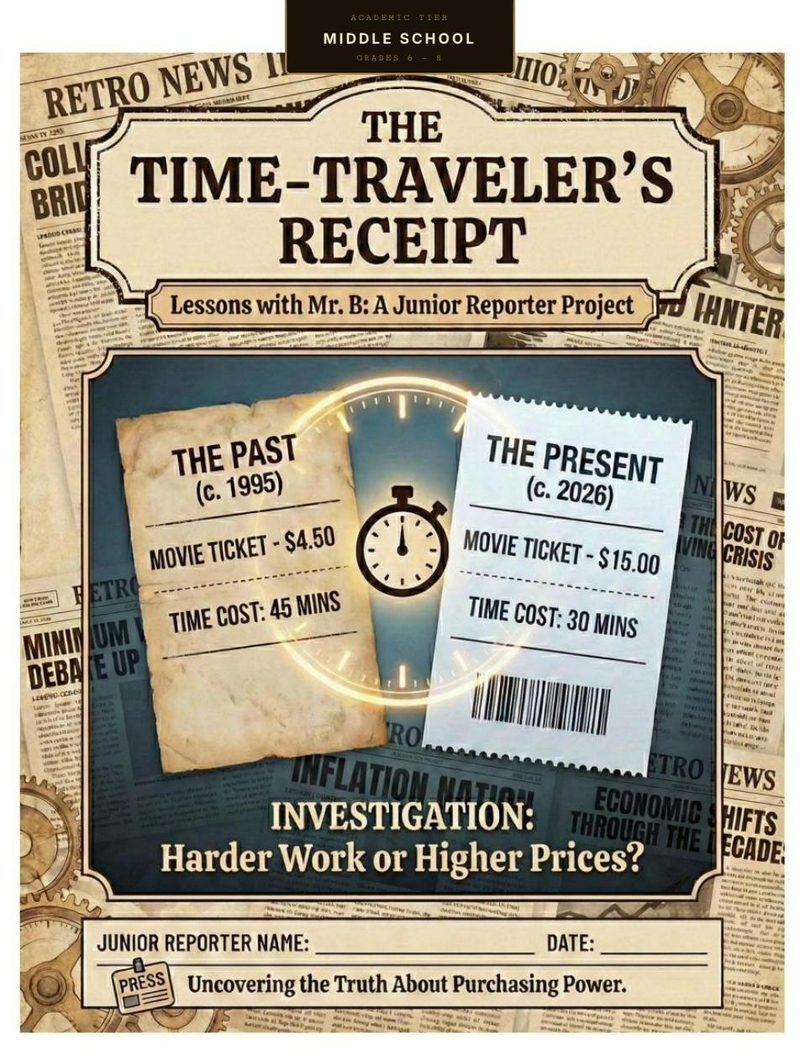
A student asked to "write a feature comparing 1995 prices to today" produces school writing. The same student, given a press credential and asked to file their first article on Mr. B's news desk, writes journalism. The cover names the role. The brief sets the stakes. The student stops writing for a grade and starts writing for the work.
Each kit is a mix of designed materials, not a stack of identical worksheets. A short letter from Mr. B sets the assignment. A topic menu lets the student choose their angle. Source artifacts give them something real to investigate. Field guides teach the craft. Drafting pages handle the messy first pass. A gold-standard exemplar shows what good looks like. A rubric closes the loop. Every page has a different job.
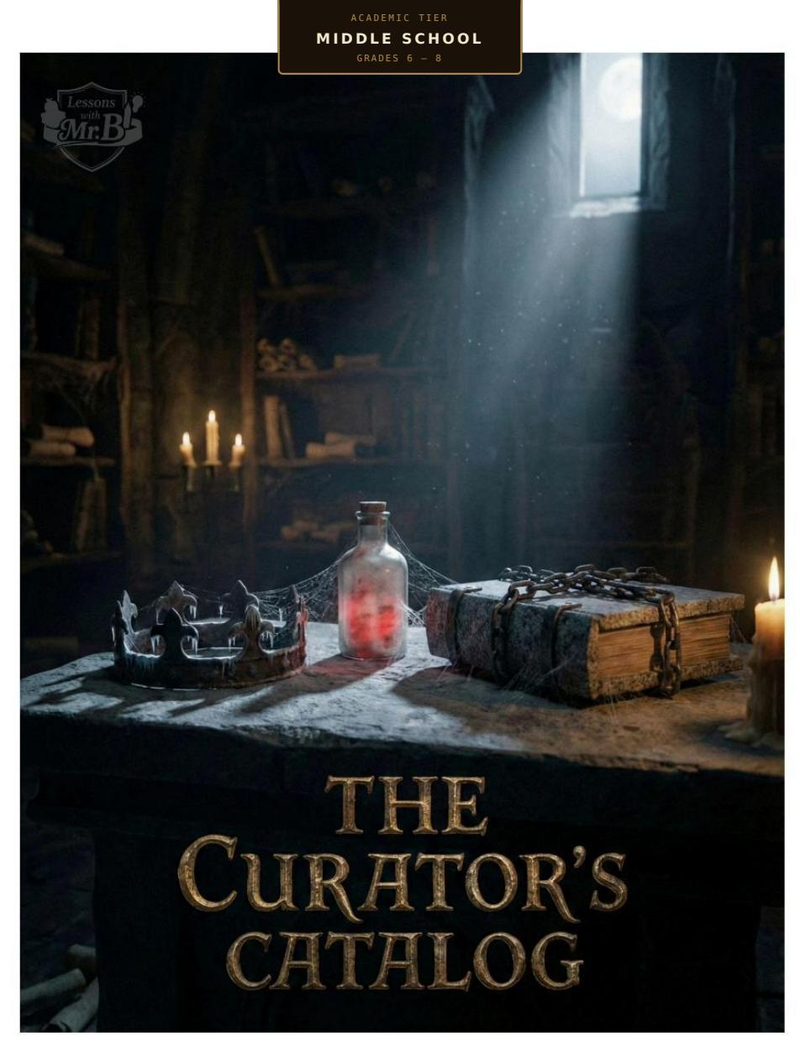
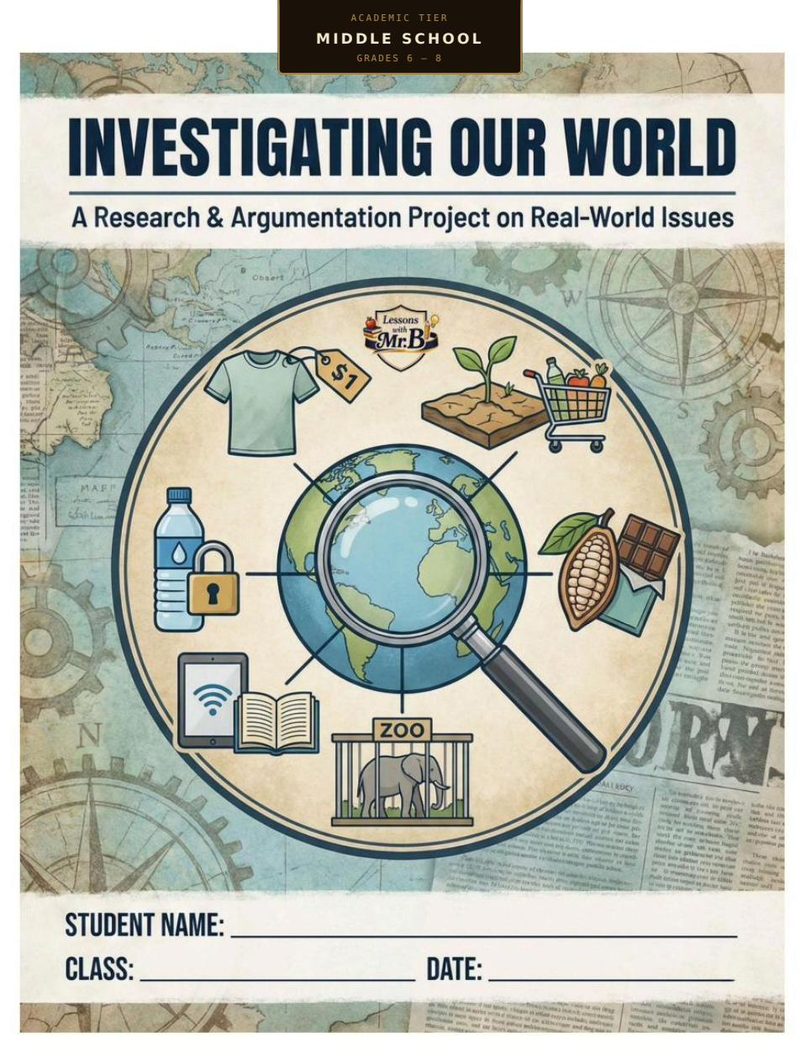
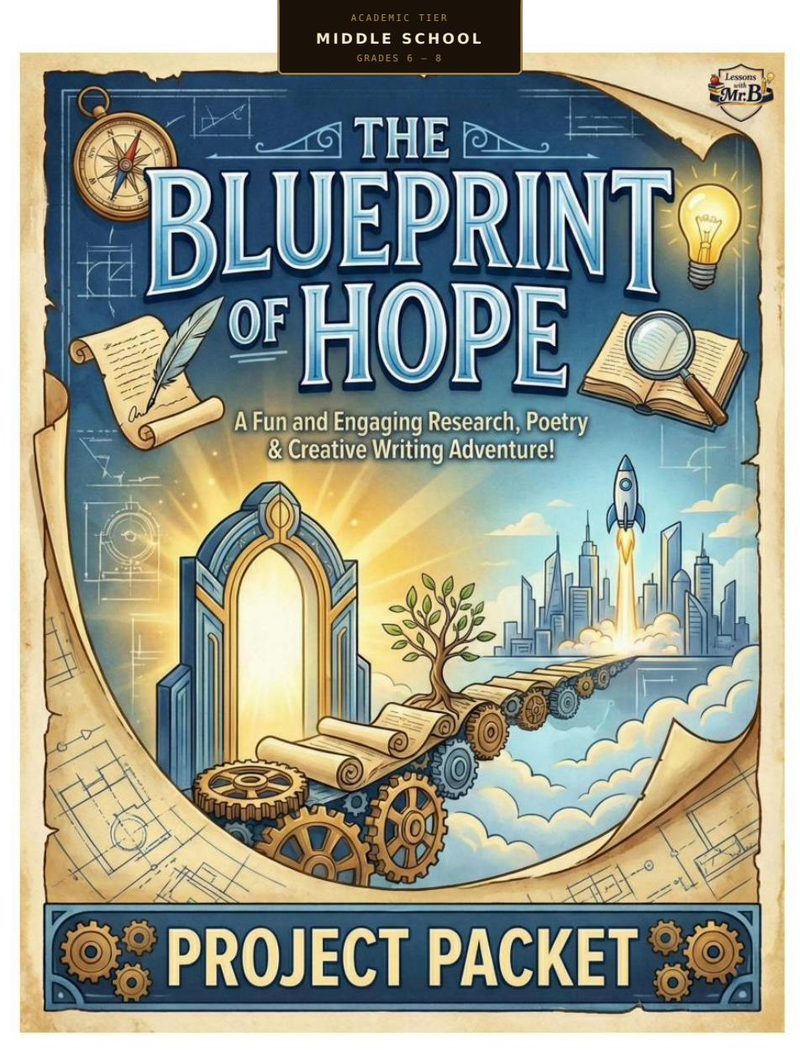
Cover images, source photographs, diagrams, primary documents. These aren't decoration. A student writing about an iron crown writes a different sentence when there's a photograph of the crown on the previous page. Every kit includes the visuals the writing needs to lean on.
What "good" looks like is shown on paper, in the same kit, in the same voice the student is writing in. Filler words like scary, very, cursed get called out, because the assignment wants the student to describe what's actually happening. The bar doesn't move when the topic does.
Each kit names its own grade band on the cover. A new kit lands on the desk every month, on the same architecture, in the same Mr. B voice.
The kits land in homeschools, co-ops, microschools, and public school classrooms differently. Pick the one that looks like your room.
One kit per student, paced to the student. The whole household covered by one purchase.
Read the method →One kit, a cohort of six to twelve students, group share-outs every Wednesday. Group license available.
See group licensing →Quietly aligned to CCSS 6 to 8. Final piece sits in the portfolio. Rigor visible to admin and parents.
School licensing →Standards alignment up front. PO and W-9 available on request. If cost is in the way, take it anyway.
Classroom access →Every kit follows the same shape, with a different role and different topics. The student opens it, picks an angle, gathers and drafts, and walks away with a finished piece they can be proud of.
The cover names the role, whether reporter, archivist, investigator, or architect. A short letter from Mr. B sets the assignment in plain language. The student knows what they're doing before they turn the page.
Each kit offers a menu of options, all hitting the same skills. The student chooses the one they actually want to write about. Investment in the topic does most of the engagement work.
Source materials and field guides hand them what they need. Drafting pages walk them through structure, voice, and revision in steps small enough to actually finish. Mr. B's notes show up where students usually get stuck.
The student compares their draft to the gold-standard exemplar included in the kit, makes a final pass, and signs the work. The parent or instructor uses the included rubric to grade. Then the kit can run again with a new topic from the same menu.
This sits on the inside cover of every kit. It isn't a marketing line. It's the rule. It's the heart of what B7 Collective is, and it's the thing I'm quietly proudest of.
A single $18 purchase covers every student under your roof, forever. Print it as many times as you need. If you're running these with students from other families, like a co-op, microschool, private school, classroom, or after-school program, pick up a copy for each family or email me about group licensing. I answer those notes myself.
If the cost is genuinely what's keeping this out of a student's hands, take it anyway. No application. No income proof. No paperwork. Email lessonswithmrb@b7collective.com, tell me which kit your student wants to run, and I'll send it. I'd rather the work happen than the file sit unused.
There are good curriculum companies out there, and many of them are excellent. This page isn't a knock on any of them. It's a sketch of what case-file pedagogy means here, written for the parent or teacher who has a stack of options open in browser tabs.
Different fits for different families. Yours just deserves a clear picture of what this is.
When the student writes scary, the rubric doesn't lecture about banned words. It says show me the teeth. Same expectations on every kit. The student always knows what they're aiming at.
"Don't tell me the crown is scary. Show me the teeth."
"Cursed is the laziest word here. If something is cursed, prove it. Rust. Smell. Chains."
"Be a detective, not a judge. Show me clues."
"Active verbs. Rust ate the metal. Not the metal was rusty."
"Notes first. Sentences later. Read it aloud. Your ear knows."
"Add the year to every search. Game Boy price gets you scalpers. Game Boy launch price 1989 gets you the receipt."
The catalog grows on a schedule. One new kit ships every month, on the same architecture, in the same Mr. B voice, under the same access policy.
A new project lands on the desk every month. Different role, different academic vehicle, same architecture every time. Sign up to the list and the new kit shows up the day it ships.
The catalog rotates across investigation, argument, atmospheric, and historical-to-future, with new academic vehicles added as they earn their place. Each kit names its own grade band and standards.
Every kit follows the same spine, the same paper-stock vocabulary, the same rubric architecture, and the same B7 access policy. A parent who runs one kit knows how to run the next one.